News

Pioneering Women in Forestry: A Women’s History Month Celebration

Prepared by Philip Chambers (March 2026)

Throughout history, women in forestry have broken barriers and shaped conservation despite facing significant challenges. In March 2025, the IUFRO Task Force on Gender Equality in Forestry (ForGEDI) launched a Women’s History Month social media campaign highlighting pioneering female foresters from across the globe. From North America to Antarctica, these remarkable women made profound contributions to forestry and environmental conservation, often without recognition. Their stories remind us that the path to gender equality in forestry has been paved by extraordinary individuals whose legacies deserve celebration.

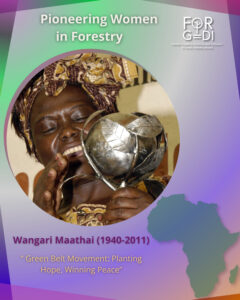
Africa: Dr Wangari Maathai (1940-2011)

Wangari Maathai by Demosh is licensed under CC BY 2.0., Design: Bora Karataş, 2025

Dr Wangari Maathai was a trailblazing environmentalist who, whilst not formally trained in forestry, became Africa’s most influential female conservationist. After earning her PhD in veterinary anatomy from the University of Nairobi in 1971 (making her the first woman in East and Central Africa to earn a doctorate degree), she founded the Green Belt Movement, which has planted over 51 million trees across Kenya and provided sustainable income to thousands of rural women.

Despite being arrested and beaten multiple times for her activism, she persevered and was later elected to Kenya’s Parliament in 2002, subsequently being appointed Assistant Minister for Environment and Natural Resources. In 2004, she became the first African woman to receive the Nobel Peace Prize for her contribution to sustainable development, democracy, and peace.

Her legacy continues through the Wangari Maathai Award, established by the UN’s Food and Agriculture Organisation to recognise outstanding contributions to forests and climate stability. She often shared the Hummingbird story: ‘I will be a hummingbird, I will do the best I can’ as a philosophy for environmental action.
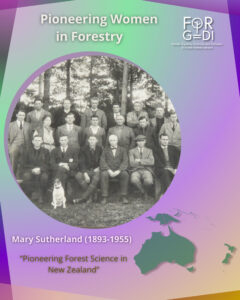
Oceania: Mary Sutherland (1893-1955)

(Courtesy of The National Forestry Library at Scion, New Zealand, Design: Bora Karataş, 2025)

Mary Sutherland made history as the first woman to earn a forestry degree in the entire former British Empire, graduating from Edinburgh University in 1916. Her pioneering spirit was evident when she joined the New Zealand Forest Service in 1924, becoming the nation’s first female professional forester. Despite her qualifications, she was initially employed at a lower rank and salary than her male counterparts.

Undeterred, she specialised in the adaptation of exotic tree species to New Zealand’s climate and developed innovative nursery techniques that dramatically improved seedling survival rates. Her numerous scientific publications became foundational to New Zealand’s forestry industry.

Many are unaware that Sutherland was also a founding member of the New Zealand Institute of Forestry (NZIF) and designed the official seal that became the foundation of the current NZIF logo. Her leadership in the organisation was significant. She served as an NZIF councillor from 1935 to 1936 and as vice president from 1941 to 1942. Her legacy endures through the Mary Sutherland scholarship, offered annually by the NZIF Foundation, which was established through her generous bequest.
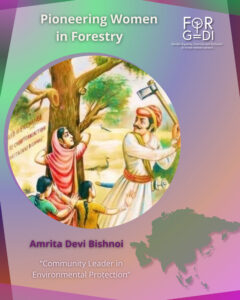
Asia: Amrita Devi Bishnoi (18th century)

Amrita Devi Bishnoi. Originally sourced from Wikimedia Commons, File: Amrata_devi_bishnoi.jpg (accessed March 1, 2025). Design: Bora Karataş, 2025

In 1730, Amrita Devi Bishnoi led one of history’s first recorded environmental protests in Rajasthan, India. When the king’s soldiers came to cut down sacred khejri trees, she and 363 members of her Bishnoi community made the ultimate sacrifice, hugging the trees and declaring, ‘a chopped head is cheaper than a felled tree.’

This brave act of resistance led to a royal decree from the Maharaja of Jodhpur prohibiting tree cutting in Bishnoi villages. The Bishnoi community follows 29 principles, many of which are centred on environmental protection, making them early conservation leaders.

Today, the Indian government commemorates this sacrifice through the Amrita Devi Bishnoi Wildlife Protection Award, and 11 September is observed as National Forest Martyrs Day in India. Her story demonstrates that women’s dedication to forest conservation extends back centuries, long before formal forestry education was even available to them.
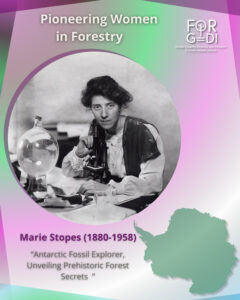
Antarctica: Dr Marie Stopes (1880-1958)

(Marie Stopes in her laboratory, 1904. Source: Marie Stopes International / Wikimedia Commons. Design: Bora Karataş, 2025)

Before becoming known for her work in other fields, Dr Marie Stopes made significant contributions to palaeobotany as one of the first women to study ancient forest fossils in Antarctica during expeditions in the early 1900s. In 1903, she became the first woman to receive a PhD in botany from the University of Munich, where her research focused on cycad plants and their evolutionary history.

As the first female academic at the University of Manchester, she undertook expeditions that required remarkable physical endurance in extremely harsh conditions. Her groundbreaking research on Carboniferous coal balls and fossilised plant remains helped establish knowledge about prehistoric Antarctic forests.

Her work in Japan (1907-1908) resulted in the discovery of new plant species and the documentation of coal formations, contributing to the understanding of forest evolution in East Asia. She also conducted pioneering research on the structure and evolution of seed ferns, helping establish evolutionary links between ancient and modern forest ecosystems. Her collection of over 3,000 fossil samples (still studied today) revealed evidence of ancient climate change, showing Antarctica once had a tropical climate.
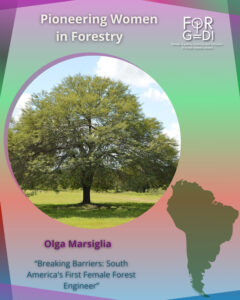
South America: Olga Marsiglia de Montenegro (c. 1940s-2017)

(Bora Karataş, 2025)

Olga Marsiglia was a true pioneer who became the first woman in South America to earn a degree in Forest Engineering. She graduated on 10 September 1963 from the Faculty of Forestry Engineering in Santiago del Estero, Argentina (then part of the National University of Córdoba).

Her journey was far from easy. When she began her studies in 1958, she was already married and a mother, which made her achievement even more remarkable. She persevered through long hours of study, limited access to forestry resources, and the challenges of being a woman in a male-dominated field. When she took her final exam in Dasonomía (Forest Science), she faced a panel of three distinguished European forestry experts and earned the highest grade.

Reflecting on her career, she once said: ‘In those years, it was rare to find women professionals in forestry, whether in Europe or Latin America. But over time, interest grew, and today, we have a high percentage of women in this field. Forests have been essential since the beginning of humanity and will remain so until the end of time. I urge young professionals to put all their knowledge and effort into ensuring that future generations inherit a green, clean, and balanced planet.’

Marsiglia’s legacy lives on, inspiring women across Latin America to pursue careers in forestry. Although she passed away on 6 January 2017, her impact on the profession endures.
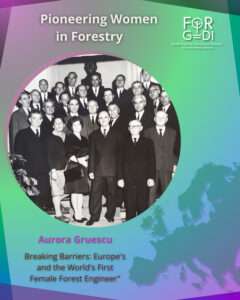
Europe: Aurora Gruescu (1914-2005)

(Photo by Cristina M Radulescu / CC BY-SA 4.0, Design: Bora Karataş, 2025)

Aurora Gruescu broke extraordinary ground as the world’s first female forestry engineer and became the first Romanian to be listed in the Guinness Book of Records. Born in 1914 in Romania, she discovered her passion for forestry at 10 during a school excursion. During this pivotal moment in a forest clearing, young Aurora made a personal covenant with the forest that would shape her entire life.

Her journey was one of determination in the face of significant odds. Initially, she pursued medicine to please her parents, but after finding it unfulfilling, she made the bold decision to switch to forestry, a field considered exclusively male at the time. At the Forestry Faculty of Politehnica University of Bucharest, she was the only woman amongst 130 candidates competing for just 13 spots. Her male colleagues refused to speak to her for two years, and one classmate even declared, ‘I have nothing to discuss with a girl about problems that are men’s.’

Gruescu’s remarkable career spanned from 1938 until her retirement in 1973. She began her career as a forestry engineer and later served as a forestry sub-inspector with Romania’s State Autonomous Forest Administration (CAPS). Even during the Second World War, she continued her work, relocating to Lugoj. Her achievements include developing Romania’s first national afforestation plan targeting 100,000 hectares and implementing innovative chemical pest-control measures in the forests surrounding Bucharest.

Branded a ‘class enemy’ under the communist regime, she had her property seized. Although later honoured by the same regime and courted to join the party, she consistently refused. After retiring at age 59, she fulfilled her dream of travelling, eventually visiting China.

Her trailblazing contributions earned her numerous honours. In 1997, she was nominated by The American Biographical Institute for the ‘Personality of the Year’ title. Her status as the world’s first female forestry engineer was officially confirmed in 2000. She was also proposed to appear on a Romanian banknote alongside 11 other remarkable women.

Aurora Gruescu passed away on 25 August 2005. Her extraordinary life inspired the book Covenant with the Mystery of the Forests by journalist Rodica Simionescu.
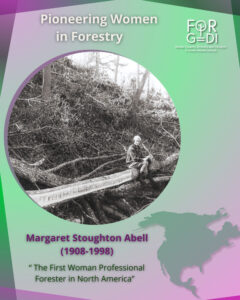
North America: Margaret Stoughton Abell (1908-1998)

Photo: Margaret Stoughton Abell / courtesy of USDA Forest Service, Southern Research Station, Design: Bora Karataş, 2025

Margaret Stoughton Abell broke barriers as the first American woman to earn a professional forestry degree, graduating from the University of Maine in 1933. During her career with the U.S. Forest Service, she pioneered research in dendrology (the study of trees) and conducted crucial studies on tree diseases threatening American forests.

Her work became especially vital during the Second World War when many women stepped into forestry roles to replace men serving in the military. Through her published scientific papers on tree identification methods, she helped establish women’s place in scientific forestry and conservation.

Margaret’s background in statistics, learnt under Professor George Snedecor at Iowa State, made her particularly valuable to the Forest Service at a time when rigorous data analysis was transforming forestry research. Her innovative use of statistical methods in publications demonstrated the important role that quantitative analysis would play in modern forest management.

Looking Forward

These remarkable women (from different continents, different eras, and different backgrounds) share common threads of determination, excellence, and dedication to forests and environmental conservation. Whether they were the first to earn forestry degrees, pioneering researchers, environmental activists, or conservation leaders, each faced significant barriers yet persevered to make lasting contributions to the profession.

Their stories remind us that progress towards gender equality in forestry has been hard-won and that we must continue working to ensure that future generations of women have equal opportunities to contribute to forest science and management.

The ForGEDI initiative continues this work through education, advocacy, and the development of resources, such as our Massive Open Online Course (MOOC) on gender equality in forestry. By celebrating these pioneering women, we honour their legacy and inspire the next generation of female foresters who will shape the future of our forests.

This campaign was developed by the IUFRO Task Force on Gender Equality in Forestry (ForGEDI). For more information about our work and to access our online course on gender equality in forestry, visit https://forgedi.org/.

#WomensHistoryMonth #ForestryPioneers #ForGEDI #EquityInForestry #WomenInForestry #WomenInScience #IUFRO #WomenInSTEAM

Scroll to Top

Piper’s Lab addresses broad questions about the competitiveness of the forest sector and focuses specifically on the dynamics of industry business and marketing practices. It is a part of Arkansas at Monticello…

FOREST EUROPE, also known as the Ministerial Conference on the Protection of Forests in Europe, is a Pan-European voluntary high-level forest policy process. Since 1990, the aim has been to develop common strategies for the 46 signatories (45 European countries and the EU) on how to protect and sustainably manage forests.

The FOREST EUROPE Sustainable Forest Management (SFM) definition and set of criteria and indicators are internationally regarded as guidelines for SFM.

The Salomón Foundation is an NGO that works to educate children and young people about food security and sustainability so they become agents of change with projection in the community.

The Salomón Foundation promoted the idea of ​​creating a Manual for rural entrepreneurs’ women. Salomon Foundation was part of the Manual´s technical committee, with three other institutions (National Institute of Innovation and Agricultural Technology Transfer – INTA; Women Association Monte del Aguacate ASEMA and National Committee of Clubs 4 S). The Foundation managed the participatory construction of the contents of the Manual.

EARTH was established by Costa Rican law in 1986 as a private, non-profit, international university and was created with the support of the Costa Rican government, the U.S. Agency for International Development (USAID), and the W.K. Kellogg Foundation.

Since 1990, EARTH University’s innovative educational approach has been preparing young people from Latin America, the Caribbean, Africa, and other regions to contribute to the sustainable development of their home communities while constructing a prosperous and just global society. EARTH offers a world-class scientific and technological education emphasizing ethical entrepreneurship and strong socio-environmental commitment. Shepherded by a prestigious international faculty, an EARTH education culminates in a four-year undergraduate degree in Agricultural Sciences.

The Barcelona Lab for Urban Environmental Justice and Sustainability examines the structural and systemic drivers of social inequalities, exclusion, oppression, and neo-colonization in cities.

The lab analyzes the extent to which urban plans and policy decisions contribute to more just, resilient, healthy, and sustainable cities, and how community groups in distressed neighborhoods contest environmental inequities as a result of urban (re)development processes and policies.

The Forest Women Network in Brazil (FWN-BR) is an independent and pioneering organisation of individuals and legal entities connecting people working or related to the Brazilian forestry sector, with the objective to promote knowledge and awareness on gender equity.

The University of Natural Resources and Life Sciences, Vienna (BOKU), was founded in 1872 and consists of 16 departments and 4 service centres and has experimental fields and forests around Vienna. InFER, the Institute of Forest, Environmental and Natural Resource Policy has profound expertise and a long-standing track record in research and teaching on institutions, instruments and processes in forest, environmental and natural resource policies. Its staff has scientific backgrounds from both social sciences and natural sciences.

EMBRAPA is involved in forestry projects throughout the country (through EMBRAPA Forestry). My team is particularly involved in the conservation activities and identifying methods genetic improvement of plants and forestry. These projects collaborated with farmer along with small and large companies from the forestry sector. In some cases, the projects also focused on female empowerment; through encouraging and creating avenues in forestry for working women in roles traditionally held by men. The team try to identify strategies, opportunities and tasks that can successfully link strategies of the organizations (national and international) to maintain the philosophies and meet the goals each organization.

Oak Ridge Institute for Science and Education supports DOE’s initiatives through STEM workforce development, scientific reviews, and environmental evaluations.

USDA Forest Service R&D guides land management decisions for the nation’s forests. Operating across research stations, labs, and experimental ranges, it sustains forest health and diversity.

The Institute for Research on Natural Resources, Agroecology and Rural Development (IRNAD) focuses on developing knowledge about natural resources, their conservation status and possibilities for sustainable use. Additionally, IRNAD studies the structure and dynamics of agroecosystems and their response to diverse management practices and territorial dynamics associated with resource utilization.

Wood Science & Engineering is one of three departments of the College of Forestry at Oregon State University. Ranked as one of the premier forestry schools in the world, students find a variety of programs that offer broad education, rigorous depth and professional focus. Caring faculty work with students to provide advising, mentoring, research experiences, study abroad opportunities, field labs, exposure to real-world practice, Traditional Ecological Knowledge and the latest scientific findings.

The Acharya Narendra Deva University of Agriculture & Technology has been established on 10th October 1975. It caters towards sustainable agricultural development and nutritional security in 26 districts having 25 Krishi Vigyan Kendras and 4 Krishi Gyan Kendras in eastern Uttar Pradesh. The main gola od the university is to produce professionals for managing green revolutions and enhancement of rural income and employment through development of agriculture & allied fields.

UN Women is the United Nations entity dedicated to gender equality and the empowerment of women. UN Women supports UN Member States as they set global standards for achieving gender equality, and works with governments and civil society to design laws, policies, programmes and services needed to ensure that the standards are effectively implemented and truly benefit women and girls worldwide. It works globally to make the vision of the Sustainable Development Goals a reality for women and girls and stands behind women’s equal participation in all aspects of life, focusing on four strategic priorities:

  • Women lead, participate in and benefit equally from governance systems
  • Women have income security, decent work and economic autonomy
  • All women and girls live a life free from all forms of violence
  • Women and girls contribute to and have greater influence in building sustainable peace and resilience, and benefit equally from the prevention of natural disasters and conflicts and humanitarian action

UN Women has a unique triple mandate: encompassing normative support, UN system coordination, and operational activities.

The International Forestry Students’ Association (IFSA) is a global student network in forestry and related sciences. With 130+ member associations in 50+ countries, IFSA connects students and organizations. It’s non-political, non-profit, and student-run and fosters cooperation, knowledge, and youth involvement in international forest processes for a sustainable future.

SLU is a university with research, education and environmental assessment within the sciences for sustainable life. Its principal sites are in Alnarp, Umeå and Uppsala, but activities are also conducted at research stations, experimental parks and educational establishments throughout Sweden. SLU brings together people who have different perspectives, but they all have one and the same goal: to create the best conditions for a sustainable, thriving and better world.

Michigan Technological University is a high research activity institution with a mission to create a just, prosperous, and sustainable world. The College of Forest Resources and Environmental Science is principally located on campuses in Houghton and a research forest Alberta, Michigan, with over 2000 hectares of land for students to explore and learn in.

CATIE is a leading regional center for agricultural research and education in Latin America and the Caribbean, specializing in tropical agriculture and conservation. Established 50 years ago in Costa Rica, it drives sustainable development through research, education, outreach, and innovation. It provides postgraduate academic programs and opportunities for applied research, alongside offering technical assistance to various stakeholders, from policymakers to farmers. Renowned for its commitment to inclusive green development.

Dr. Cora van Oosten has more than 30 years of experience in landscape approaches, landscape restoration and landscape governance in Africa, Latin America, Asia, and Europe. She has worked as project manager, advisor, and researcher, always in combination with capacity development and collaborative learning on the ground. Through practice, she has learned how to design and deliver offline, online, and blended learning trajectories that work for both informal and formal education. She believes in the power of edu-technology for translocal and ‘glocal’ learning for sustainable and inclusive landscapes. She is currently working as Head of Capacity Development & Education at CIFOR-ICRAF, based at CIFOR-ICRAF headquarters in Bogor, Indonesia. Her task is to strengthen CIFOR-ICRAF’s ‘science-for-impact’ profile and develop a cutting-edge programme on capacity development & education. She does this in close collaboration with CIFOR-ICRAF country programmes and education partners, exploring new models for transformative learning in science and practice.

SNS (Nordic Forest Research, or SamNordisk Skogsforskning) is a cooperating body, financed with Nordic funds under the auspices of the Nordic Council of Ministers that strives to enhance benefits for the Nordic region and contribute to a sustainable society. The members are Iceland, Norway, Sweden, Finland, Denmark and the independent areas of Åland, Faroe islands and Greenland.

The Université de Moncton is the largest french-speaking university in Canada’s Atlantic provinces, but also welcomes students from around the world. The École de foresterie is situated at the Edmundston campus, in the heart of New Brunswick’s forestry region. A four-year Bachelors degree prepares graduates for professional practice anywhere in Canada and a Masters program provides for research in forest management, human dimensions, geomatics and other fields.

Makerere University is Uganda’s largest and oldest institution of higher learning, first established as a technical school in 1922. Today, Makerere University is composed of nine colleges and one school offering both undergraduate and post graduate programmes to about 36,000 undergraduates and 4,000 postgraduates. The University is extensively involved in teaching, research and outreach programmes with local, national and international stakeholders.

The Thünen Institute of Forestry (TI-WF) is one of the 15 specialized institutes of the Johann Heinrich von Thünen Institute, Federal Research Institute for Rural Areas, Forestry and Fisheries. TI-WF provides science-based decision support and concludes action options for policy and practice. The research focus of the Thünen Institute of Forestry addresses the topics related to “forestry in Germany”, “forestry worldwide”, “forest products markets”, and “forests and society”.

Michigan Technological University is a high research activity institution with a mission to create a just, prosperous, and sustainable world.  The College of Forest Resources and Environmental Science is principally located on campuses in Houghton and a research forest Alberta, Michigan, with over 2000 hectares of land for students to explore and learn in. 

The School of Environment and Sustainability, University of Saskatchewan offers several professional program streams at the graduate level, in addition to thesis-based graduate degrees. SENS’s programs are designed with flexibility and balance in mind to accommodate individual work, family, and life circumstances, while providing you with the mix of marketable skills required to address a variety of United Nations’ Sustainable Development Goals (UN SDGs).

The Department of Land, Environment, Agriculture and Forestry (TESAF) is a modern and multidisciplinary University department, and part of one of the oldest Universities in the world. Our activity is strongly oriented to the study, conservation, effective management and sustainable use of agricultural, forest and natural resources.

The University of Padua is one of Europe’s oldest and most prestigious seats of learning. As a multi-disciplinary institute of higher education, the University aims to provide its students with professional training and a solid cultural background. The University of Padova was one of the first universities to award a PhD title to a woman, Elena Lucrezia Cornaro Piscopia.

The Free to Grow in Forestry initiative aims to achieve gender equality and meaningful inclusion of equity-deserving groups (women, Indigenous Peoples, new Canadians, global majorities, 2SLGBTQI+, people living with disabilities) at all levels from technical to executive level positions in the forest sector.

Center for Social Inteligence is an organisation that since 2013, has promoted the value of diverse and inclusive workplace cultures, offering realistic, actionable guidance for leaders.

IUFRO is a non-profit, non-governmental international network of forest scientists, which promotes global cooperation in forest-related research and enhances the understanding of the ecological, economic and social aspects of forests and trees. IUFRO is “the” global network for forest science cooperation. It unites more than 15,000 scientists in around 630 Member Organizations in almost 120 countries, and is a member of the International Science Council. Scientists cooperate in IUFRO on a voluntary basis. ForGEDI MOOC was developed under the IUFRO Task Force on Gender Equality in Forestry.

The Forest Stewardship CouncilTM (FSCTM) is an international, non-governmental organisation. FSCTM unites individuals, businesses, governments, and NGOs under a common goal: protecting healthy, resilient forests for all, forever.
FSC’s certification system enables businesses and consumers to choose wood, paper and other forest products made with materials that support responsible forestry. Embracing diversity is essential to the FSC’s core strength of bringing different stakeholders together to address challenges and co-create new forest solutions. Work in diversity includes equality for workers, Indigenous Peoples, local communities, and gender equality. For many of these diversity elements, FSCTM has built approaches to promote equality in the certification scheme.